

The following story was reported by The Utah Investigative Journalism Project in partnership with Utah News Dispatch and St. George News.
A law passed in 2024 allows just three school districts to decide what books can be removed from school library shelves across the state for obscene content. But records obtained by The Utah Investigative Journalism Project now indicate one of the most prolific school districts for banning books may have been doing so in violation of state law, leading to the removal of “obscene” books statewide based on recommendations from book-ban activists.
Let Utah Read is a grassroots coalition fighting book bans in the state. The organization attempted to examine Washington County School District’s process for removing books from school libraries and classrooms by requesting relevant public records. The district denied having any records about its policy or how it was implemented.
Once Let Utah Read appealed the denials to the state government records director, however, the district released a copy of its policy as well as batches of emails of district employees discussing how the policy would work. Those emails, shared with The Utah Investigative Journalism Project, show that the Washington County School District had created an “informal” process for removing books from school shelves and classrooms different from state law.
“If somebody wants to make a challenge they have to have standing,” says Jessica Horton of Let Utah Read. “So they have to be either a student, a parent of a student or an employee of the school district.” But the emails and documents from the district showed it allowed “informal” complaints from people without standing to challenge books in a process that did not have the same opportunity for public review and parental involvement as required by law.
“They’re just bypassing that,” Horton said.
The Utah Investigative Journalism Project provided training and consultation on filing open records requests to Let Utah Read in keeping with its nonprofit mission to offer free open government training to journalists, nonprofits, citizen groups and members of the public. The Utah Investigative Journalism Project also helped Let Utah Read appeal Washington County School District’s denial of records under the Government Records Access and Management Act, or GRAMA.
In addition to revealing the district’s “informal” book-banning policy, the records obtained through the appeal also indicated that the district should have had many more records when it had previously claimed that “none existed.” This led to a contentious hearing before the government records director where the school district had to explain not only the opaque “informal process” but why it didn’t have records about how it actually worked in practice.
‘Thank you so much for your efforts’
When the initial 2022 book ban legislation went into place that allowed parents to challenge books in their students’ school district (but not trigger statewide bans) a few St. George residents immediately began appearing at school district meetings asking about implementation of the new law.
The school district even issued a statement that fall in the St. George News that it was concerned about activists coming into school libraries even though they had no children enrolled.
“Some community members, not parents (of students), have entered our schools without authorization and have been warned that for the safety of the students, they are not allowed to enter the libraries for their own purposes, or they will be trespassed from the schools,” said district spokesperson Steven Dunham.
The statement came after uproar from some citizens that books that had been flagged for obscene content had been returned to library shelves because the process for removing the books did not follow the newly enacted state law.
That fall St. George News also reported that women complained about the new law at a Washington County Republican Women’s monthly meeting. One woman objected that she was told she didn’t have standing to challenge books because her children were home schooled. She also protested that she had been unfairly banned from the school libraries for searching for obscene books.
Email documents show that in response to one woman’s frequent book challenges, the district started taking a new approach, outlined in an Oct. 6, 2022, email.
Washington County School District Technology Director Jeremy Cox wrote the woman to let her know that a new policy was in place. He explained how the formal process from the newly passed state law would require challenged books to be sent to the District Review Committee and that only individuals with standing could file those complaints.
But, he said, the district was creating a separate “informal” process. In this process anyone could complain to a school employee about obscene material.
“Material that may be removed without a formal challenge must be identified as material containing a ‘Description or depiction of illicit sex or sexual immorality’ that by law ‘has no serious value for minors,’” Cox wrote.
The employee would then put the book on hold, confer with other employees, and remove the book if they agreed it met the legal definition of obscene or pornographic content.
Cox explained that his staff did not have the time to review the whole book, so for the informal process he asked her to send information about the book, verbatim quotes and specific page numbers for staff to review.
A separate undated email provided to Let Utah Read appears to show Cox instructing district staff about this new informal policy, writing that:
“It is critical that we seriously consider any of these complaints regardless of who they come from,” Cox wrote. “When a material meets this definition, it is illegal for us to have the material in the school. In these cases, we should be grateful for the help that any individual is willing to provide to identify these materials.”
A year later Cox wrote to the book-ban activist, updating her on a recent list of challenged titles.
“On a side note, thank you so much for your efforts; some of these materials are clearly inappropriate for the school setting,” Cox wrote. “Please know that the librarian responsible for procuring the specific materials I’m referring to is no longer employed by the school district.”
Horton is shocked by a process that uses a loophole to avoid the requirements of state law. Instead of a formal process, the emails suggest a handful of school employees making a decision on their own, possibly with no involvement by any student’s parent.
“Like there are references to ‘committees’ in those emails, but I think it sounds like it’s just librarians that are on that committee,” Horton said. “There’s no parental involvement, which is what the state law requires. And then like how many people are reviewing it? Is it one? Is it two? The process is completely opaque.”
According to the Utah State School Board’s guidance, the first step in reviewing material for obscenity involves a review group of at least three individuals that includes a community parent and cannot include the staff member who procured the book nor the individual who brought the complaint.
The emails provided to Let Utah Read show that one individual had challenged 58 books, with 27 of them being banned. But, according to the district, there have only been three formal challenges. The rest came through the “informal” process.
Let Utah Read hoped that requesting records under GRAMA would provide some answers about this shadow book review committee, but the emails the group obtained only brought up more questions. So Let Utah Read appealed the district’s claim that there were no more records to the newly created Government Records Office. What ensued was a very unorthodox hearing.
‘This process was not taken seriously’
Susan Hiner with Let Utah Read explained to Government Records Director Lonny Pehrson, who is tasked with adjudicating GRAMA appeals, in a June 4 hearing that the email referenced numerous other records that were never provided — including spreadsheets, Google docs and other documents. She also pointed out that the informal process referenced meetings that also produced no records of how district employees decided to ban books “in direct contradiction to Utah state law and the district’s own policies.”
“It cannot be said that these books magically disappeared from the district’s library shelves with not any record of why or how,” Hiner argued.
Terry Hutchinson, who presented himself as legal counsel for the Washington County School District, explained that all the records of formal challenges — all three of them — had been provided to Let Utah Read.
He said the “vast majority” of the challenges were for books challenged in the other process he referred to as the “Bright Line” where the books have content clearly defined under the Utah criminal code.
“In common terms, essentially, the book is to be removed and if you gave that book to a minor out on the street, theoretically you can be arrested for providing children with pornography,” Hutchinson said during the meeting.
He said this process can sometimes just involve a phone call and then a couple school employees that “just stand by each other’s desks and say ‘Hey, here’s what I found in this book,’” Hutchinson said. “They look at the book and then they determine whether or not it violates the Bright Line standard.”
He added that there’s “not a lot of paper trail” in the process.
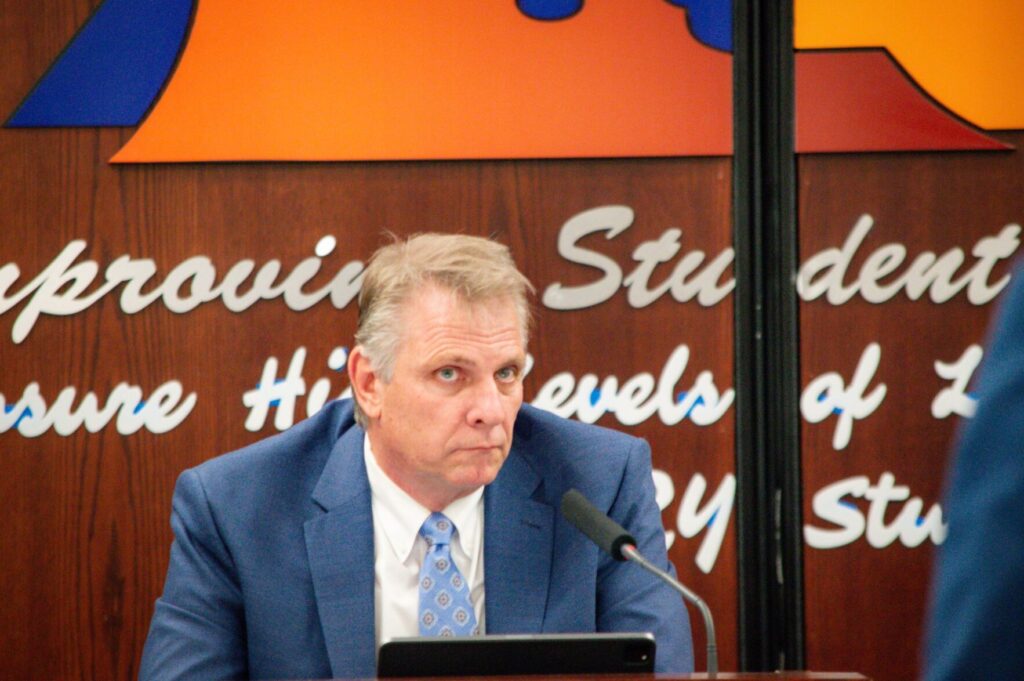
As government records director, Pehrson reviewed the emails that had been provided to Let Utah Read and after deliberating ordered the school district to go back and conduct a further search for more records. Pehrson agreed with Let Utah Read that clearly there were other records the district did not provide. He also ordered they provide a written explanation of their search and to identify whether any records had been lost or destroyed. The district has 30 days to comply or appeal the decision in district court.
Pehrson also went on record to express his disappointment with how the school district had handled the hearing. Under GRAMA the district was supposed to provide a written statement of facts to the director and to Let Utah Read, explaining their arguments before the meeting. But the district did not.
And during the hearing, which was conducted virtually, Hutchinson presented his arguments at the same time he was driving a vehicle.
“I also want to just go on the record that I think it’s inappropriate for counsel for the district to appear while driving and I also am concerned that no statement of facts was provided,” Pehrson said. “I think it just shows that this process was not really taken seriously.”
What happens in Washington County
Ed Carter is a First Amendment attorney and law professor who has successfully fought and won cases where local governments improperly closed public meetings. His reading of the state law seems clear about an open and public process that involves parents and officials in making important decisions about the content their children can read. Those decisions should involve public meetings and well documented decisions with records that are easy to access.
“I would think that the spirit of the law trends toward an open, transparent process. And I mean, one of the values of that is having community support for whatever the outcome is,” Carter said.
“Ultimately the school board needs and relies on public support and so if they’re not doing things in public, how does the public know whether to support what they’re doing?”
Davina Sauthoff is the Library Media Educational Specialist for the Utah State Board of Education. She provides training to school districts on the review of sensitive materials. She said she has not heard about the Washington County School District’s informal policy and stresses the board’s role is not to provide that level of oversight over how the districts implement their policies based on the state law.
She also stated that when school districts report the books that they have removed, the state board relies on the district’s representation that the removal was done in line with state laws and regulations.
“We are really there as a support,” Sauthoff said. “Accountability and oversight, that would not be our role.”
She did say administrative rules provide a hotline for people to file complaints about how the processes are being conducted and if they are complying with the state law, though she’s not aware of any such complaints being filed about the Washington County School District.
Washington County School District was asked if the “informal process” clashed with state law and spokesperson Steven Dunham deferred to Hutchinson’s comments explaining the process at the hearing.
What’s troubling for Let Utah Read is that the Washington County School District’s policy led to book bans there and triggered bans across the state in a process shrouded in mystery.
For Hiner, the lack of transparency is concerning when it comes to taking books away from children, books that could “support them, that can illuminate their life or that can help them through rough times.”
“What Washington County does, it’s not protecting kids from porn, it’s narrowing their intellectual life,” she said.
If you support the work we do and believe in the power of a free and independent press, please consider making a tax-deductible donation to The Utah Investigative Journalism Project by visiting utahinvestigative.org/donate.
Leave a Reply