



The following story was reported by The Utah Investigative Journalism Project in partnership with Salt Lake City Weekly.
The Utah Department of Transportation’s decision to buy the property of a former top lawmaker in May for $8 million raised more than eyebrows.
Some residents and elected officials raised their voices against the sticker shock of buying the property that could eventually be the base station for the controversial Little Cottonwood Canyon gondola project. Cottonwood Heights Mayor Gay Lynn Bennion challenged that the property was worth about half the purchase amount.
UDOT defended the appraisal process and said it was an investment that would be much cheaper than going through eminent domain in the future and kicking homeowners off the property. The payment went to the property owner, Quail Run Development LLC, a company managed by Chris McCandless, a former longtime Sandy City councilmember and his partner, Wayne Niederhauser, the former president of the Utah Senate.
While UDOT considered the purchase a wise investment, what wasn’t fully explained was how the state decided that coming up with the $8 million figure meant ignoring the risk of environmental contamination of the property.
The Utah Investigative Journalism Project obtained a copy of the property appraisal from UDOT through an open records request. The document contains what are called “Extraordinary Assumptions,” in the lingo of professional appraisers. The assumptions state that the property “was part of a superfund program to clean the soil of arsenic and lead,” but that “an assumption of the appraisal is that the subject land is free from contaminants.”
But the appraisal also cautioned that: “The use of any extraordinary assumption or hypothetical condition may have affected the assignment results.”
In an interview, a top UDOT official stated such assumptions are very normal and stressed that the “area was deleted from the EPA’s Superfund program’s National Priorities List on July 27, 2018.”
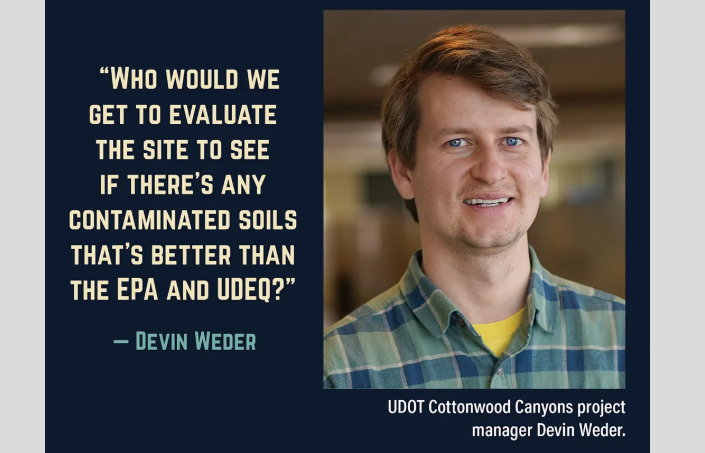
Devin Weder, UDOT’s project manager for the Cottonwood Canyons, also said it was cleared by the Utah Department of Environmental Quality.
“Who would we get to evaluate the site to see if there’s any contaminated soils that’s better than the EPA and UDEQ?” Weder asked in a recent interview.
Neither agency, however, said the area was free of contamination. In fact, UDOT’s own environmental impact study includes a letter from UDEQ warning that sites deleted from the National Priority List “may contain contaminated material and future construction activities associated with this project may encounter hazardous substances.” EPA information, likewise, said the property is not ready for development and may still be a human health risk.
Extraordinary Assumptions
UDOT said the appraiser followed their own standards and was not instructed by UDOT to make that assumption. The appraisal also said “An environmental assessment report was not provided for review.”
UDOT said an assessment was not provided because the site had been removed from the EPA’s priorities list and had been remediated.
McCandless, one of the real-estate developers who sold the property to UDOT, said everything about the gondola project has been clouded in rumor and misinformation. He said he commissioned an environmental study in 2020 that determined that since the soils were remediated there was not “a significant environmental concern on the subject property.”
“The EPA and the state have given us a clean bill of health,” McCandless said. “Everything people are saying about that is just false.”
While soils were remediated to a depth of 18 inches and a clean cap placed on the ground, the EPA has not given the site a green light for development, or even determined that it is protected against human exposure to harmful contaminants.
At the time of the appraisal, the EPA Superfund site stated that because of updated lead guidance, there was insufficient data to show the site was free of lead-contaminated soil and there would not likely be enough data to make that determination until 2029. The Superfund site even warned residents near the property to consider having children tested annually for lead exposure.
The EPA site also classifies that the sitewide area is not ready for anticipated use, meaning there may be unacceptable risks for development. While that big, possibly toxic, question mark hangs over the development, UDOT shared no environmental assessment with the appraiser, but the appraiser felt it necessary to still acknowledge the uncertainty of the position by declaring the “extraordinary assumption” in the appraisal document.
Bill Garber is the director of international growth and strategic relations for the Appraisal Institute, the nation’s largest association of professional appraisers.
He said “extraordinary assumptions” often help appraisers protect against legal liabilities by disclosing that “we are just assuming this is correct, with what information we have today, as we understand it.”
He said the appraiser wouldn’t likely have the environmental expertise to make an assessment like that, but the buyer could get an expert to provide that kind of report to the appraiser to figure into their calculation. Such an arrangement is typical with many real estate deals.
“A lender would look at that and ask ‘Is there a need for remediation? And how much does that cost?’” Garber said.
McCandless, when shown information from the EPA’s Superfund site, said he had never seen it before. He questioned the concerns raised on it given the study his company had paid for in 2020, although this was also before the EPA updated its lead exposure guidance in 2024.
He admitted if the land was contaminated it would hurt property values. He said that if he had not sold the parcel to UDOT and had planned instead on developing it into homes he would commission a new environmental report.
“I would do additional research like any normal person would,” McCandless said.
This was not UDOT’s thinking.
UDOT project manager Weder, however, said if the gondola project does receive funding the agency could then investigate further.
“That’s when we would really do the site investigation to find out if any other remediation was necessary,” Weder said.
While UDOT didn’t conduct an environmental review, they did have some research to reference. McCandless said he provided them the 2020 report his company paid for during the negotiation.
While the Superfund site information says it’s uncertain how toxic the ground is on the property, what is certain is that at the time of UDOT’s appraisal the easily accessible EPA Superfund site said the area was not ready for development and was instead encouraging nearby residents to test their young children for lead exposure.
Fair Market Value
UDOT project manager Weder stressed that the appraisal is just a tool when it comes to purchasing properties for future transportation projects. It’s about reaching an amicable deal now to avoid a contentious eminent domain battle in the future.
“This isn’t a negotiated sale,” Weder said. “We don’t go into this and say ‘Hey, we’re trying to get the number as low as possible.’”
For Bob Douglass, with Friends of Little Cottonwood Canyon, there’s a problem with that deal. The buyer in this case, UDOT, is using someone else’s money—namely, the taxpayers.
Had Quail Run developed the property as homes, every home would have to disclose to potential buyers that digging below 18 inches would mean contact with toxic soil, which would likely result in the developers paying for more cleanup to sell the homes, Douglass noted.
But what would be a red flag for an average buyer, wasn’t for UDOT.
“So the end result was that Quail Run got an extremely good price for a piece of land that would have cost them a lot of money to develop on their own,” Douglass said. “Excellent deal for them, not a very good deal for the taxpayers.”
While agreeing that buying properties now to avoid costlier acquisitions in the future is smart, he also pointed out that the law for using these preservation funds states the fund is for “high priority transportation corridor preservation projects.” But the Utah Transportation Commission does not list the area as one of its designated high priority corridors.
UDOT said in a statement that “The gondola is not on the separate High Priority Corridors list because the Little Cottonwood Canyon project proceeded through its project-specific Environmental Impact Statement and Record of Decision process.”
McCandless said the deal with UDOT was meant to help the gondola project. He’s a full throated supporter of the project because he believes it’s safest in providing another exit from the canyon during emergencies, will address congestion to keep up with Utah’s explosive growth and be the most environmentally friendly option.
McCandless also said the UDOT deal was not meant to improve values of his nearby development. While he has developed a neighborhood with 13 homes near the recently sold parcel, he points out that three are under contract and the rest have been sold.
The last one will be off the market years before a gondola is ever built. “The gondola is not going to be built until 2040,” McCandless said. “By then I’ll be in a hole in the ground.”
For Douglass, UDOT simply seems to be bending over backwards to accommodate the gondola project and the politically connected developers who champion it while shirking meaningful investments in enhancing bus service.
“It seems like it’s enriching a few powerful people who were already rich rather than solving the problem to the best of the taxpayers’ pocketbooks,” Douglass said.
If you support the work we do and believe in the power of a free and independent press, please consider making a tax-deductible donation to The Utah Investigative Journalism Project by visiting utahinvestigative.org/donate.
Leave a Reply